Monday, September 3, 2012

Burning the ladies

 
It is a magic world.  Mix a little dirt and water, make mud.  Squeeze it, dry it scratch and scrape it into a form, then put it in a fire - it turns into stone.  What materials are in the mud?  What temperature the fire?  For how long?  How much oxygen do you allow in to touch the clay?   Materials.  so much fun. 

I have burned ladies in America.  But this is my first time in Japan.

First the ladies:


raw dry clay
 
in the tin can with a bed of wood chips and torn up test papers
 
 
start the fire
 
inside had just enough oxygen to make charcoal
 
after the fire

 
the smaller one came through it fine
 
the bigger gal needed a little Elmer's
 

I am not making tea cups for the queen.  For my work I like the older materials and methods.  I love the feel, the color, the weight of these ladies that come from a low fire wood burning technique.  I have tried electric and gas kilns.  There is no comparison at all.

The next question is what to do with these ladies now that they are done?  I had thought to put them into my wooden boxes, but that was long ago, before the idea of the inside paintings came along.  Now... who can say.  And with any luck I will have one more burn before October's exhibition.


Thursday, August 30, 2012

Old Wood


20 years ago I visited a temple on a hill in Nara above the big Buddha.  I found some old wooden panels, painted on 1000 years ago.  The paintings were done with sumi ink, but in 1000 years the wood had darkened to almost the same color as the ink that was painted on it.  In a few spots the artist had used white.  I expect when it was painted the white was nearly invisible, but now it stood out vividly.  I have often wondered if the artist had known the wood would change so, and so much change the paintings.  How could he not?  But again, how could he expect that most of his lines would disappear?

Time and time. 

This summer I have started to paint on wood from the Meiji Era, using sumi ink, seeing it when I paint it on and watching it almost disappear when it dries.

This is a painting I did last week of the Kokyo.


Kato-'s Gate 2012

One thing leads to another.  this is a painting of a party at my house.


Saturday Night  2012
 
And after the party:
 
home alone 2012

Wednesday, August 15, 2012

Hidden Voices


 Trees have spirits in Japan.  They have souls. 

 We lost another tree in our garden, a big old kiri tree.  We had lived with this tree, watched it naked in the winter, full in the summer, swept up its leaves in the autumn, big broad leaves. It was a wonder. 

I kept the pieces to remember.  I stacked them carefully to dry.  Then I started to work on them.  I started digging - Was I looking for it's soul,  or was I trying to save my own?
It felt good to work on them, to make something new from the fallen tree. 

I made an inside space.  After a time, and to my surprise, I started to paint on the inside walls. 

Painting inside was new. 

 I was no longer painting in 2D. The back wall was a flat space.  The back wall was a space I was accustomed to, but next to it was another plane, and then the top, and the bottom and the other side. I found myself making a painting in 5 different directions, all connected. To do it I had to create new tools. I made brushes that painted around corners.

But more important than brushes, I had to have a new way of thinking, 5 planes interconnected, but different.  I looked at ancient cave paintings for education.

And later I turned to the mandala.  I noticed that the 5 different planes inside my wood mirrored the 5 circles that make up a mandala.

As is often the way with painting, one step informs the next. Each new step is an adventure and an education, allowing, or suggesting the next.

Work continues.  With luck I will have some things to show in October.


nothing virtual

Sitting in my studio, working on a new piece of wood I realized how opposite of virtual it was. 

It is heavy.  It takes up space.  It is only here - it is in one place. And it is 3D.  It is more than 3D - it is 3D on the outside, and on the inside it is 5D, or more.  Inside it has a top, bottom, 2 sides and a back, all five planes interrelated.

It has a touch, a surface, a complex of texture and hardness. It even has a smell.  This piece is made form kusunoki (yukliptis wood)


It does not translate to virtual.  It is not possible to properly translate it to a screen.

Thursday, August 2, 2012

I found a little block of wood, a gem, don't ask me where.  I will say that the rich kid students at Tokyo Geidai this season are clearing out thier studios and getting rid of thier treasures.  If you know where and when to look, before the garbage truck, it is amaizing what can be found.

I found a little block of wood.  I liked its size and feel.  It was certianly well seasoned.   I thought it was lauan or some other  kind of soft hardwood.

Today I cut into it in my studio and what a fragrance.  It is kusunoki, canphor wood.  What a treat.  I hope I can use it in a worthy way.

My treasure.

Wednesday, July 4, 2012

MotoKi, Adachi-Ku

I rode my bike over the big bridge that spans the Sumida and Ara rivers, up above the Senjus and discovered a little part of Adachi-Ku that seems to have been forgotten.  Tokyo has been growing and changing.  This place did not.  In this little part of Adachi there are rice fields almost hidden behind thick hedges and vegetable gardens the same.


 Old farm houses, and a "Sells everything" sort of local shop.


There was a little coffee shop.  I ordered the breakfast set, generous with eggs and jelly on toast English tea, a little salad and a bowl of miso soup, my first time in 20 years of breakfast sets to get miso soup.  And to top it all every customer that left the shop before me stoped to nod and say something Some gave a full bow.   There was amazing wall paper art on the main wall, faded and tobacco stained, an image of the great New York skyline, from the queens side, he artist only choose to show one bridge, the Brooklyn.  But the main image in the foreground was the space age buildings and wide  large runways of Leguardia Airport.  It was the size of a big Fuji painting in a sento, but this one was not like a Fuji.  This was about "Empire"  It gave me a chill.


One the way back toward the river at the end of my ride I passed a 90 year old man zooming the other direction in an electric wheel chair, smoking a big new white cigarette, and further along a 100 year old woman wrapped and covered every inch of skin, as farmers do, bent and working in a vegetable field.

Tuesday, June 19, 2012

Typhoon and urushi

A typhoon is raging outside.

 I am working about my wood finish.  I have 3 things made, shrines?  objects?  Caves?
Anyway, the next step is the finish.  I love Japanese urushi.
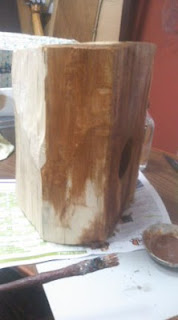
 Urushi is a hard subject to speak about.  Americans translate it to the word, lacquer.  But lacquer in American English means any hard shiny paint.  Urushi in Japan is much older.  It is a natural tree sap, from a tree similar to poison ivy.  Anyway the sap can have a similar effect on people, the raw sap.  For me it used to be ok, but now can give me a heck of a rash.  I only use it in a well ventilated area and with rubber gloves.  It is dangerous, and quite expensive, but I can't resist using it.  The finish is like no other, hard and strong, but rich and deep in a way that varnish, oils and waxes are not.
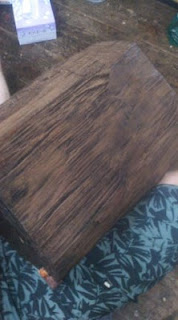
The darkness of this urushi surprised me. When it reacts with air, and water It darkens.  Water is important.  Lacquer can not harden with out humidity in the air.  It is one reason it so well fits Japan.  Lacquer is unique in the way that it goes on, very light and milky, but quickly darkening  I have used it before, but previous times it had turned out a bit lighter, more of a honey tone.  I wonder if it is the wood, or a different lacquer supplier?

With a little rubbing it is becoming interesting.  Lacquer is volatile and dangerous in its raw form, but when it hardens it is a strong, nonreactive, safe and natural finish.  More safe than a usual substitute, cashew nut oil, which turns out to be carcinogenic, something that lacquer is not.  Lacquer is safe, has been for 1000 years.